
Feature
Receiving the Gift of Life:
Naomi Lee’s heart for helping others
Sadie McDonald
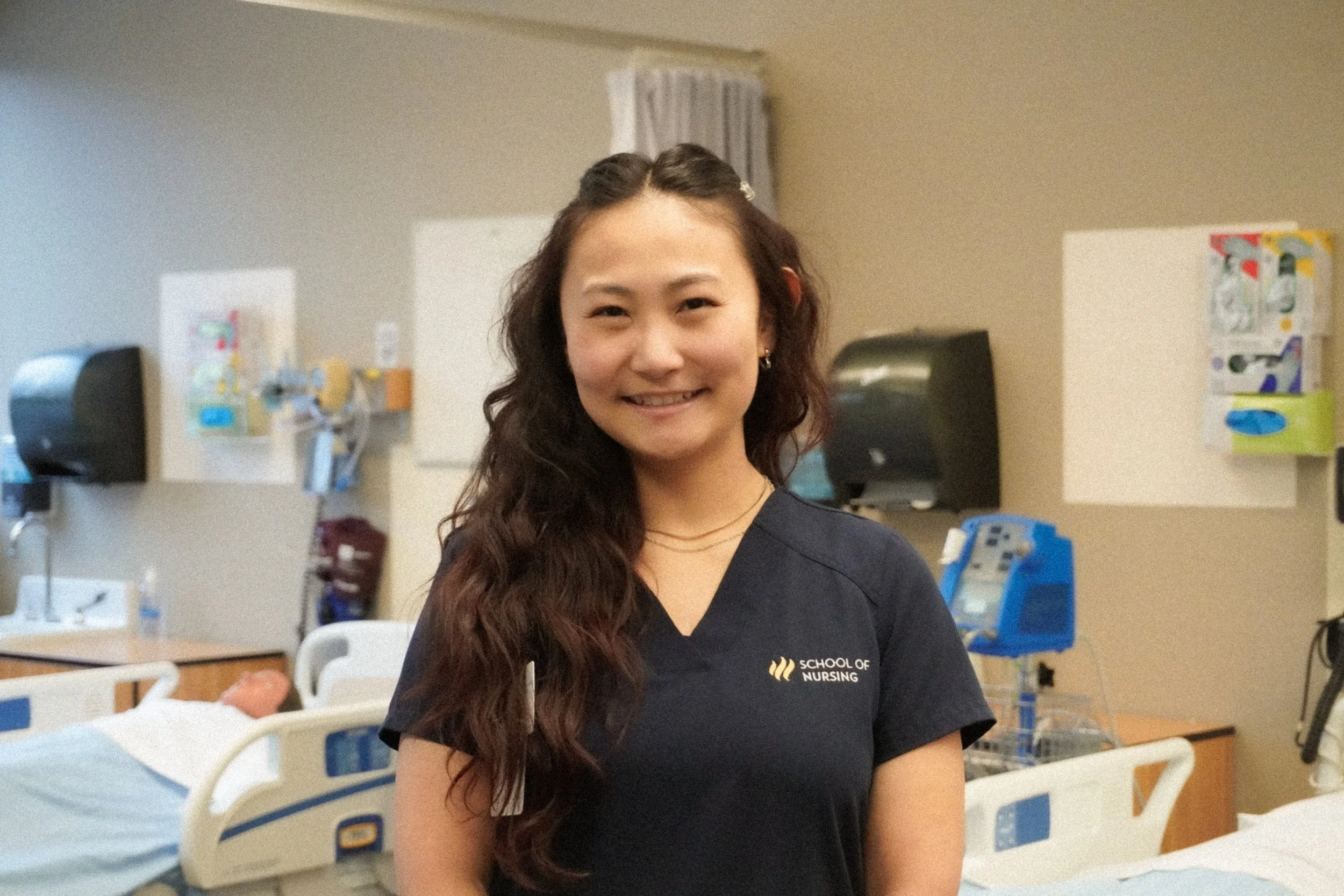
Third-year nursing student Naomi Lee never intended to pursue a career in healthcare. That was until June 2020, when the then-19-year-old and her siblings caught the flu. While they recovered, Naomi ended up with pneumonia and viral myocarditis, which is inflammation of the heart muscle caused by a viral infection. According to Emergency Care B.C., symptoms of myocarditis include chest pain, palpitations and fatigue. It was during that first hospital admission when Naomi was told she had congestive heart failure (CHF)—news that came as a complete shock to the previously healthy teenager.
Sent home on medication and a salt and fluid-restricted diet, Naomi lived with heart failure for two months. Unfortunately, she did not respond to the medications and her CHF worsened. When Naomi returned to the hospital, ventricular fibrillation sent her into cardiac arrest; she was defibrillated and CPR was performed for 20 minutes before she was put on life support. Six days later, Naomi underwent an emergency surgery to have a left ventricular assist device (LVAD) implanted in order to help her heart pump blood to the rest of her body.
“Recovering from the LVAD surgery was one of the most difficult and painful experiences of my life in every way—physically, emotionally, spiritually and mentally,” she recalled. “I was honestly still in denial. I was only 19. This [didn’t] make any sense. . . . I didn’t get a say in that surgery because it was an emergency, and I wasn’t conscious for that decision.”
Naomi’s doctors had hope that her heart would recover on the LVAD, avoiding the need for a transplant; however, an echocardiogram performed six months post-emergency surgery determined that her heart muscle would never recover, making a heart transplant Naomi’s only option. In total, Naomi lived with an LVAD for 10 months, and fortunately, she only had to wait three and a half months before she got the call that a donor heart was available. Naomi received her heart transplant on July 17, 2021, and her surgery was complication-free, resulting in only a 10-day hospital stay. She is required to take immunosuppressants to prevent her body from recognizing her donor heart as foreign and rejecting it. “I have to take a big handful of pills twice a day, 12 hours apart. My anti-rejection medications are for the rest of my life, and that is what is keeping me alive. I regularly drive out to St. Paul’s Hospital to get a four-month supply,” Naomi said.
Unfortunately, these medications are not without side effects, including a decreased ability to fight off infections and an increased risk of developing cancer, especially skin cancer. “I am also really careful about germs because my immune system is suppressed, so I get sick a lot more easily,” Naomi explained. “I get sick for longer, and then sometimes it hits me harder. I’m mindful about [hanging out with] my friends if they’re not feeling well.”
It was difficult for Naomi to articulate all the ways her life has changed since her transplant, but two of the biggest changes include her decision to study nursing and a new perspective on life.
“I was in education, and I love working with kids. I was really excited to be a teacher, honestly,” she recalled. “But then, after my transplant, I felt that I really needed to try nursing. Being a nurse was never something that I wanted to do, or thought that I was capable of doing. I had to start from scratch, [but] I’m very happy with my decision.”
Now close to five years post-transplant, Naomi’s positive outlook on life has decreased her anxiety. “I can absolutely see how going through a crisis like I did can make somebody very afraid, and there are aspects of my life where I am very afraid. But in terms of like mental health, I actually have changed for the better,” she said.
“I don’t have anxiety about all the things that I used to have anxiety about. . . . I can’t care as much about what people think [because] at the end of the day, I know it’s not the end of the world.”
Currently working as an employed student nurse on a medicine unit, Naomi has also given back to the community through volunteering with B.C. Transplant (BCT) by sharing her story with classes at Douglas College and being a member of BCT’s Social Media Ambassador Program.
According to BCT, an organ donor can save up to eight lives. When asked what she wanted readers to know about organ donation, Naomi said, “Anyone can be an organ donor. It’s really easy, and it only takes two minutes to register. I want people to know that it doesn’t affect doctors trying to save you if you’re in an accident. There’s truly nothing else that can be done when you get to the point where your organs are able to be donated.”
However, Naomi also acknowledged that this is not always a straightforward decision. “I think it’s always hard to talk about death, and I want to be sensitive because the reality is that somebody’s loved one is dying in a sudden and tragic way,” she said.
“I just want to acknowledge that even though we don’t talk about death specifically when we say be an organ donor, we are. It is absolutely life-changing and life-saving. There are people who have very little quality of life without a healthy organ, and I wouldn’t be here if I hadn’t gotten a heart transplant. You’re saving someone’s life.”
It is because of this gift of life that Naomi is now looking forward to her future nursing career after graduating from TWU. “I know that I want to help people, and I know that nursing makes a really big impact because I’ve experienced that. I’m really excited to make a positive impact in people’s lives,” she told Mars’ Hill. “When a nurse walks in, doesn’t acknowledge you, and just pokes, prods and moves on, that feels really bad. It’s not that hard for a nurse to walk in, . . . look you in the eye and put their hand on your shoulder. It’s not that hard to be kind, and it makes a big difference. I know the power of a wonderful nurse, and I want to be that for people.”
To register your organ donation decision in the B.C. Organ Donor Registry, please visit https://register.transplant.bc.ca/.